Photograph CT

After logging many miles together with our cameras over the highways and back roads of Connecticut, getting up before sunrise in hopes of creating that spectacular shot, my friend and I decided to share our discoveries with others who would also like to photograph the special places of Connecticut.

This project to photograph CT began in 2009, when the two of us first met volunteering in the beautiful gardens at Hill-Stead Museum in Farmington. It is fitting that the first posting on this blog will be that site.

We hope this blog gives you ideas of new places to go, whether you live in CT, vacation here or are just travelling through. Look for a tourist tip along the way: we share some of our favorite eating places or shops in some of the places that we go back to over and over.

Most of the places we talk about are within easy walking distance from the road, although there might be a few that might require a bit of walking to get to scenic points or lookouts. This will be noted in the descriptions. Most locations identified are accessible to the public, and do not need a reservation. Most are free, but when there is an entrance or parking fee, this will be indicated.

The sites are divided geographically into five sections:

* Southwest Connecticut

* Litchfield Hills

* Central River Valley

* The Shoreline

* Eastern Connecticut (including the Quiet Corner)

Search the 'labels' using these locations as keywords to find other places within a geographic section.

There are so many photo opportunities in this beautiful state, and I'll be adding new locations regularly, so check back often. You can also follow the blog to be notified when new locations are added.

So whether you like to shoot landscapes, nature, wildlife, gardens and flowers, architecture, street scenes or people, follow along, and we'll take you on a scenic tour through this beautiful, historic and picturesque state!


Showing posts with label Central River Valley. Show all posts

Friday, August 23, 2013

Hot Air Balloon Festival in Plainville


Seasonal Rating:  Spring N/A      Summer ****     Fall N/A     Winter N/A

Two balloons lift off over the trees on Saturday morning
The Hot Air Balloon Festival in Plainville is one of the only festivals of its kind in New England. It is held on the fourth weekend in August, and runs from Friday evening through Sunday. The schedule may change year to year, but in general, on Friday evening there is a balloon night glow, with the balloons strutting their stuff aloft and aglow. This is followed by a fireworks display, beginning at 9:30 pm. On Saturday and Sunday, the balloons lift off early in the morning, starting about 6:00 am and fly off to their destinations. There is another lift off at 6:00 pm on Saturday. Also on Saturday, there is a car and motorcycle show. Food vendors and a craft show run throughout the entire weekend.


What to Photograph

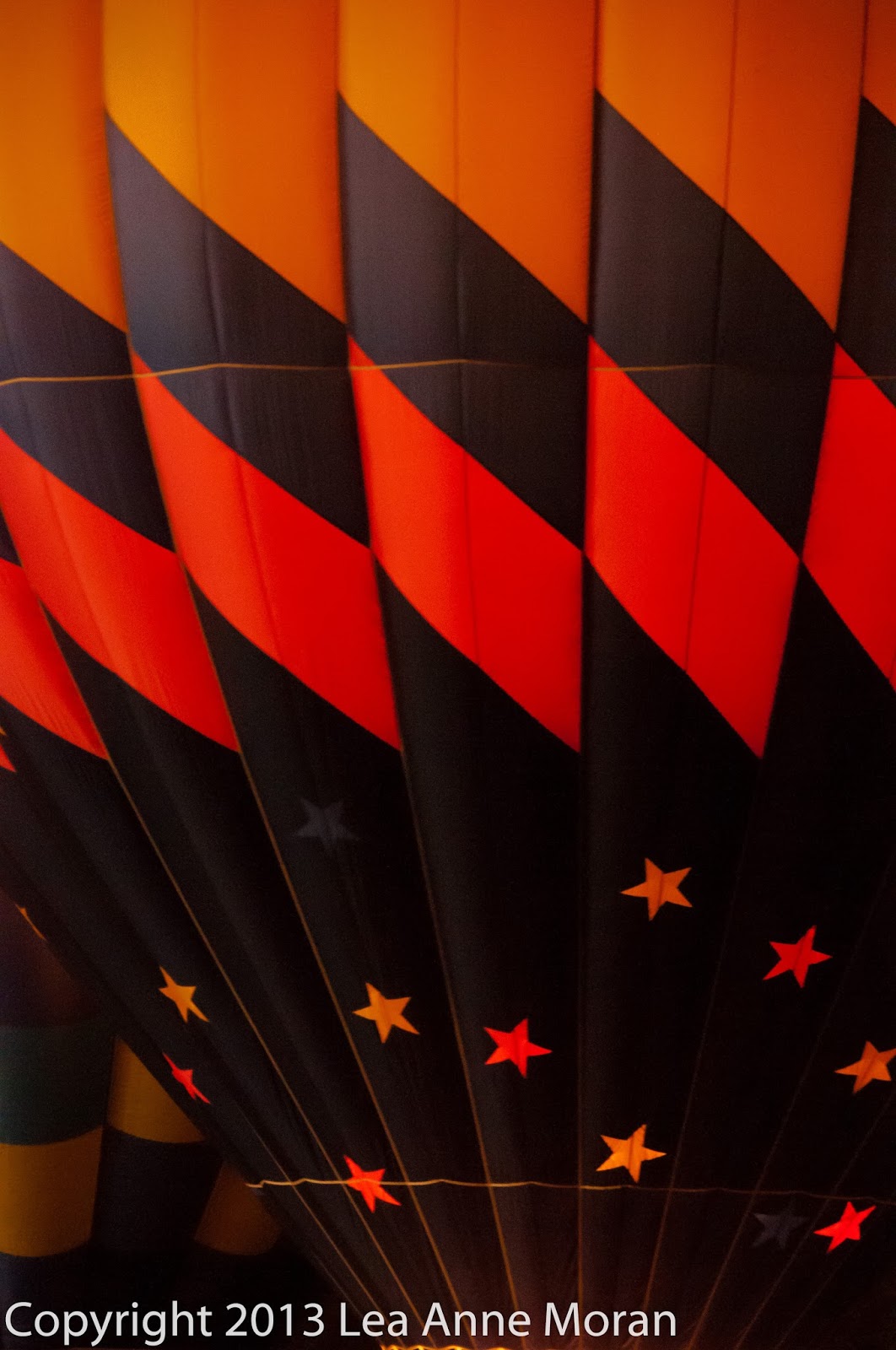
The balloons are most colorful when they are set against a clear blue sky, but when they are aglow at night, this can provide an opportunity for a different look against a dark sky. There are a lot of opportunities to capture the flames as they fill the balloons, the people holding the ropes and riding in the balloons, or the crowd watching it all. 
At the balloon glow Friday night
 
Every balloon has its own flair
Look for the details, like this wicker basket that holds the riders


Filling the balloon with hot air

Shooting flames and a view of the interior of the balloon

Pretty patterns and colors
There are tethered balloons, giving people brief balloon rides up into the air, and these are easy to photograph if you want to shoot some details of the colors and the people. You can take a ride in one of these balloons, for a fee, if you want to see what you can see from about 100 feet above ground. The ride is brief, but you might capture a different view of the balloons, or of the sunset if your timing is right.
In the morning, when the balloons are launched, you have a chance to capture a single balloon or a group of them in the sky together. You have to move fairly quickly because the balloons may disappear over the horizon before you know it.
On the Friday evening, as a fundraiser for the fire department, people are allowed to go inside a balloon that is stretched out on the ground. This attracts a lot of people, kids and adults alike, and it is a wonderful place to be creative with your camera. You can get a shot of the colorful fabrics and shapes from the inside, or capture the kids and the families having some fun against a brilliant and colorful background.
And of course, you might decide to stay to photograph the fireworks display after the balloons are deflated. Make sure you get situated in a good position so you can get the fireworks in the air, and perhaps some of the crowd in the foreground. If the day is overcast, you might try your hand at photographing the vintage cars or motorcycles that are on display, but on a bright day, you have to be careful not to get a lot of reflections in the shining paint and chrome.


When to go

Try to arrive early on Friday evening if you choose to go then. There is a lot of activity going on around the park, and it gets pretty crowded. If you go for the launch on Saturday or Sunday, try to arrive about 5:30 am. The balloonists start to set up quite early, and you might find some good shots. It's a chance to get your bearings and be ready for the take off when they start to go. The balloons don't go off all at once, but rather one or two at a time, so you have lots of opportunity to capture something.


Tips and Techniques

There are a lot of people attending the festival, and it might prove tricky to set up your tripod safely and out of the way. You might decide to shoot hand-held at this event, so be prepared to set your camera on shutter priority and increase your ISO to give you a better chance to get a clear image. Turn on your vibration control (VR) if your camera has it, and set your shutter speed to 1/60 second or faster.

For photographing the cars and motorcycles, you might remember to bring a reflector or a diffuser with you to help cut the glare. You may try to shoot some details, and the diffuser will help soften the light.


Directions

Norton Park
72 Norton Trail,
Plainville, CT
860-747-2521

Map coordinates (for GPS): Latitude: 41.68121, Longitude: -71.915573

Parking is available at the park, and on the streets in the neighborhood. It is best to arrive early, since this is a popular festival and draws a large crowd, especially on the Friday evening. It might be a good idea to carpool to the park if you plan to go on Friday.
The festival is held the fourth weekend in August, and is run by the Plainville Fire Department. The hours are as follows, but check the website for potential changes.

Friday: 6pm - 10pm (balloon glow begins at dusk)
Saturday: 6am - 9pm (balloon launch begins at 6:00 am and 6:00 pm)
Sunday: 6am - 9am (balloon launch begins at 6:00 am)


Tourist Tips


There are food vendors at the festival, so if you plan to be there early, you can always have festival food to eat while you watch the balloons. 

Saturday, July 6, 2013

Rosedale Farms and Vineyards, Simsbury

Seasonal Rating: Spring **     Summer ***     Fall ***     Winter *

Rosedale Farms and Vineyards operates a market garden farm as well as a winery. It is a fifth-generation farm and has been operating since 1920 in various renditions. It created a niche in the winery business when the owners planted a four acre vineyard and produced their first vintage in 2005. The farm is located near the Farmington River in the Weatogue section of Simsbury, and with its freshly painted barns, the vineyards, and lush fields of vegetables and cutting flowers, it provides a scenic setting for photographers.

What to Photograph

During the summer and fall, the vines, vegetables and cut flowers provide lots of opportunities to capture the feel of times gone by on the farm. After becoming a winery, the barn received a new look and now sports a coat of vivid red paint, adorned with oversized green grape leaves. There are various pieces of vintage farm equipment and trucks on the property that make for interesting subjects. Try composing your shot with a vintage plow or truck in the foreground when photographing the bright red barn to get a contrast between the old and new. Take a few close-ups of details of the trucks or cultivators that are strategically placed on the property.
Of course, in the late summer or fall before the grapes picked, you can get up close with the full bunches on the vines. Look for the different colors of grapes, from yellow-green to deep purple. Try shooting the rows of grapevines, using the lines to give your shot perspective, or to draw the viewers eye to another object, such as the barn or vintage truck.
Starting in late June or early July, the cutting flowers come into bloom. Follow the road past the grapevine barn to the fields of sunflowers and other cutting flowers. The field of sunflowers runs back to the stand of trees, which gives a good solid green backdrop for the tall sunflowers. They don't bloom until later in July, but once they start, blooms continue throughout the summer. An adjacent field is overflowing with colorful zinnias, snapdragons, asters and other annuals used to make the arrangements sold at their market stand.

Painted barn adorned with grapevines 

When to go

The warm summer months, from June through September, are the best time to visit Rosedale Farms. Early morning hours give a nice backlight on the vines and grapes, when you can look for dew drops and soft light to backlight the grapes and outline the leaves. The rising sun shines across the fields of flowers, as well, giving a pleasing glow. The sunflowers face the rising sun in the east, which makes it easy to get their faces when you are positioned on the farm road. Try to go by in the winter and spring if you want to photograph the buildings and capture the starkness of the vines against the land.

Tips and Techniques

Get down low to photograph the grapes, with the sun backlighting the grapes for a nice glowing effect. Use a reflector to fill the dark shadows, if you think it's necessary.

Directions

Rosedale Farms and Vineyards

25 East Weatogue Street
Simsbury, CT 06072
860-651-3926
GPS coordinates: Latitude: 41.851339, Longitude: -72.798576

Store hours: 8:00 am to 6:00 pm, in season. (Check the website)
Parking is available in the small lot by the farm stand.

Tourist Tips

Pinchot Sycamore

The historic Pinchot Sycamore tree is the largest and oldest sycamore of its type in Connecticut. It's worth a stop to see the tree, and perhaps photograph it. It suffered some damage in the late October snow storm of 2011, but it is still an amazing tree with branches that reach out like a giant's arms, as if to grab the cars driving by. There is a little parking area just north off Route 185 beside the Farmington River.
Route 185, enter across from Nod Road
Simsbury, CT

 Heublein Tower

Heublein Tower is a six story structure on the top of Talcott Mountain. It overlooks the town of Simsbury and off into the distance of the Litchfield Hills and is visible from Bloomfield to Canton and beyond. It is best to photograph in the late day when the sun is shining on it from the western sky. It almost glows when the light is right, and is a much photographed icon of Simsbury. There are many spots to photograph this tower from. Try driving along Hop Road, south from Route 185, or south on Hopmeadow Street, and stop when you find a parking lot or side street with a good view.
Talcott Mountain, overlooking Simsbury

The Garlic Farm, West Granby

Seasonal Rating:  Spring N/A      Summer ***     Fall***     Winter N/A

The Garlic Farm is a small market garden farm in the village of West Granby. They specialize in vegetables and fall crops, especially garlic, onions, and shallots. It is open for the season when the vegetables are ready for harvest, which means sometime in July. In addition to doing local farmers markets, they sell produce directly from the farm. The crops are grown in the fields surrounding barn, as well as in neighboring fields.

What to Photograph

Garlic by the yard laid out to dry
There are bins and bins of garden produce, both inside and out at the farm-stand, which is located in an old barn first used to dry tobacco. It is painted a nice bright red, which provides a good backdrop for the colorful sunflowers and other flowers that bloom in the cutting garden out back. The cutting garden is full of zinnias, extra-large black-eyed Susans and vivid orange Mexican sunflowers. Towering sunflowers are sometimes thrown into the mix, but have the honor of their own special garden to one side. If your passion is shooting the bright yellow flowers, you can go all out there. With a bright blue sky and the great red barn, it's fun to be creative with the big happy sunflowers.
The vegetables make for interesting photographs, too. They are all displayed in bins, which are stacked  outside the entry to the barn. There are several varieties of tomatoes, including many heirloom varieties. Heirlooms come in all kinds of interesting colors, including yellow, orange, striped yellow and rosy red. Even the familiar tomato-red varieties come in all shapes and sizes. There's also a big selection of peppers, all wonderful to photograph when they are grouped together on display. Other vegetables you might have fun experimenting with are eggplants, potatoes, squash, pumpkins, and of course garlic, which is displayed in bins, and hung from the rafters to dry. Later in the season, there are braided garlic ropes as well.

When to go

Zinnias bloom later in July until frost and stand out against
the red barn once used for drying tobacco
The selling season starts in June, when the farm opens on weekends only to sell the early season garlic scapes. Beginning in July, when the first tomatoes are harvested, the farm stand is open daily, except Mondays. The best time to go is July through October when there are lots of colorful vegetables and loads of garlic drying in bunches, and the cutting garden flowers are in bloom. In the fall, pumpkins, winter squash and fall mums provide lots of colorful opportunities for photographers to be creative.
Late afternoon is also a good time, when the sun is low in the sky and the rows of tomatoes behind the old tobacco barn are bathed in a nice golden glow.

Tips and Techniques

Peppers of all kinds are on display; use a diffuser if the light is bright
to avoid 'hot spots'
Early morning light is good, but it might be best to hope for a bright overcast day to get the best light for the vegetables. Since the bright light really adds a lot of highlights to the shiny vegetables, like tomatoes, peppers and eggplants, it's best to find a shaded location where you can take your pictures. Also, remember to bring a reflector to balance the light, or try a make-shift one with poster board or foil. A diffuser is helpful also, if you are doing close-ups in a bright light.

Directions

76 Simsbury Rd 
West Granby, CT 06090
860-653-0291
GPS coordinates:  Latitude: 41.951305, Longitude: -72.837858
Limited parking is available right at the farm stand.
Hours:  10:00 am to 6:00 pm July through October. Closed Mondays. Check the website for opening day and special events.

Tourist Tips

There are a couple of breakfast places in Simsbury, which is the closest town to the farm. Harvest Cafe Bakery is a local favorite, and is always hopping for breakfast and lunch. It is somewhat hidden in a small strip mall.

Harvest Cafe Bakery

1390 Hopmeadow Street
Simsbury, CT 06070-1411
860-658-5000
Hours: Monday - Saturday: 6:00 am - 2:30 pm; Sunday: 7:30 am - 1:30 pm

Peaburys Cafe

12 Hopmeadow Street
Simsbury, CT 06070
(860) 658-2930
Hours: Monday, Tuesday: 7:30 am-4:30 pm; Wed: 7:30 am-9 pm; Thurs-Fri: 7:30 am-8 pm; Sat: 8 am-10:00 pm; Sun: 8:30 am-4:30 pm 

 Holcomb Farm

Holcomb Farm CSA is located almost directly across the road from the Garlic Farm, and may provide another stop for photographers. There are several interesting buildings and barns, all painted red with white trim, which would make for interesting shots. They also plant a field of sunflowers, sometimes close enough to the road, to be able to photograph. 

111 Simsbury Rd
West Granby, CT 06090
Hours: Does not open for sales to the public.


Friday, July 5, 2013

Enders State Forest and Waterfalls, Granby


Seasonal Ratings:  Spring***     Summer****     Fall****     Winter***


Enders State Forest Park was established in 1970 when the family of John Ostrom Enders and Harriet Whitmore Enders donated the land to the state. With additional land donated by the family in 1981, and another purchase by the state in 2002, it now encompasses 2098 acres of rich forest, with a river flowing through the rocky terrain. On one side of Route 219, you will find a small parking lot with a pair of trails leading to a series of waterfalls, which cascade over several rocky drops. Driving just a little further along Route 219, turn right onto an old gravel road that runs through the state forest, and leads to a marshy bed, just loaded with wildflowers that bloom throughout the season.

What to Photograph

Anyone who wants to practice their skills on photographing waterfalls will be in glory at this location. There are six waterfalls within a quarter mile stretch of the river, and all are just a short walk along the trail from the parking lot. Some say that this is the best collection of falls in the state. Most of the cascades have a good drop over a rocky ledge, creating a pool of water below. Most of these gorges are good for swimming, so if you go in the middle of a hot summer day, expect to find some locals cooling off in the pool below the falls.
If you are looking for wildflowers growing in a natural habitat, this is a great place. There are wildflowers that bloom from spring through fall along the marsh found inside the forest on the north side of Route 219. In the spring there are trilliums, jack-in-the pulpit, forget-me-not and skunk cabbage. If you're lucky and are there at bloom time, you'll find the native ladies slipper orchids tucked away in the forest. Later in the summer, the edges of the marsh fill up with water loving plants like the brilliant red cardinal flower, turtlehead, wood aster and arrowhead.

When to go

Textural reeds at the marsh
Waterfalls are great to photograph anytime of the year. Go on a bright, overcast day so that you can use a slower shutter speed to soften the water. Try to avoid the middle of a bright, sunny day when the harsh light creates strong shadows and contrast on the water. Winter is a good time for capturing some ice on the falls, or in the pool below. However, this depends entirely on what type of winter weather is occurring on a given year.
To photograph the wildflowers in the marsh, try going in spring to catch the early blooms. It's great to go later in the summer season when the marsh is dryer and it's easier to walk around and get up close. You'll find a surprising amount of color with the brilliant red cardinal flowers, turtlehead and other native flowers at their peak.

Tips and Techniques

A polarizer filter and neutral density filter are must-haves when photographing waterfalls. To get the soft water effect, a slow shutter speed is necessary, and these filters help reduce the light to get that cotton candy effect. Use a tripod, and try taking multiple shots at shutter speeds that are 1 stop apart, to use for HDR later. Combining shots into an HDR program creates an extra softening effect on the moving water.

Directions

From the intersection of Route 10 and Route 20 in Granby, head west on Route 20 for 3.8 miles to Route 219. Take Route 219 west for 1.4 miles to parking area on left with sign 'Enders State Forest'.

GPS coordinates: Latitude: 41.95417, Longitude: -72.87778

Wildflowers abound in the state forest like these flowers
of the arrowhead plant
Late summer cardinal flower glows beside the marsh


Parking is available in the lot on Route 219, marked with the sign 'Enders State Forest'. Head downhill along one of the trails leading from the parking lot towards the river, where it meets an old road that runs parallel to the water. The trail on the right end of the parking lot will take you to the top waterfall. Follow the path downstream to the left to get to the other five waterfalls in the series. Across the road, and a little further down, there is a rough road leading to the wildflower marsh in the state forest. Park along the road to access the marsh.


Hours: Sunrise to sunset. 

Drake Hill Flower Bridge, Simsbury

Seasonal Rating: Spring ** Summer *** Fall *** Winter * 

Drake Hill Flower Bridge overlooks the Farmington River
The Drake Hill Flower Bridge in Simsbury is the only bridge of its kind in Connecticut, and was inspired by the Bridge of Flowers in Shelburne, Massachusetts. The metal-truss bridge, built in 1892, is lined on both sides with 48 flower boxes that are planted to the brim in the spring with colorful annuals. By early summer, the flowers are dancing with joyful color, overflowing their boxes, and providing a colorful foreground to the views of the Farmington River, visible for several hundred yards in either direction. At both ends of the bridge, there are small flower beds filled with perennials that bloom throughout the season.

What to Photograph
Flowers drape over the historic bridge from baskets and boxes
The brilliant display of colorful blooms makes a great subject, both for flower portraits and close-ups, vignettes of the flower boxes, or as foreground for longer landscapes of the river and wooded surroundings. You might also use the colorful bridge as a backdrop for portraits of people. It's a popular spot for wedding photographs, and is often visited by walkers, bikers and other sight-seers during the warm summer months when the blooms are at their peak. When to go The peak time is during the warm summer months, from June through September, but depending on the weather, the blooms may last well into October. Go early in the morning for good soft lighting on the flowers, and perhaps a mist over the river. Later in the day or early evening is also good for lighting, but you will find more people at that time of day. Tips and Techniques Try bringing a reflector to direct the light onto the flowers, especially when you are working with a nice backlight from an early sunrise. If the light is brighter than you would like, use a diffuser to soften the light and avoid harsh shadows.

Directions
Drake Hill Road and Old Bridge Road
Simsbury, CT 06072
860-658-3255
For More Info, click here

Map Coordinates (for GPS): Latitude: 41.868858, Longitude: -72.79983

Parking is available in the small lot at the west end of the bridge.

Hours: Open to the public; no set hours.

Wednesday, July 3, 2013

Hill-Stead Museum, Farmington

Seasonal Rating: Spring ****     Summer ****     Fall ****     Winter ****

Hill-Stead Museum is one of Connecticut's best known historic house museums, and is visited by many for the renowned collection of impressionist art which includes original pieces by Monet, Degas, Manet, Whistler and Cassatt. The house was built at the turn of the 20th century by Alfred and Ada Pope, in the colonial revival style. Their daughter, Theodate Pope Riddle, fell in love with the area when she was attending Miss Porter's School in Farmington, and convinced her parents to move from Cleveland and build their home here. An aspiring architect, she designed the 19-room home that her parents retired to, and she was later to inherit. The property includes several buildings, all designed and built by Theodate over the half century of her involvement. In addition to the house,  there is a stone garage that once served as a stable, a carriage barn, and an adjoining building known as the Makeshift Theater.
The house is set up on the highest point of the 250 fifty acre property, overlooking the Litchfield Hills to the west, and surrounded by former farm fields to the north and meadows to the south. Immediately south of the home is a beautiful Sunken Garden that occupies a one-acre natural depression. This is a formal flower garden that was designed in 1920 by Beatrix Farrand, America's first female landscape architect. Today it has been restored to its original grandeur, with formal beds full of perennials and annuals from spring through fall. The beauty begins with tulips in April and ends with a striking color scheme of blue, purple and white to complement the vivid colors of fall foliage.  This garden is a real gem, surrounded by hedges, eight foot high stone walls, and with a green and white summer house at its center.

What to Photograph

Colonial Style Architecture
While you cannot use your camera inside the home, you are free to use it around the grounds to photograph the mansion and the other interesting buildings, as well as the Sunken Garden and the surrounding property.  There are numerous buildings from the early 20th century on the grounds to explore and photograph. The mansion itself with its tall white columns enclosing a porch with slatted rocking chairs is reminiscent of George Washington's house at Mount Vernon.  The house itself has interesting lines, and in the early morning light it shines from the north side. The little caretakers cottage to the south sits quietly beside the meadow where the sheep meander from spring through fall. The stone garage, the carriage barn, the Makeshift Theater all surround the house, and provide many interesting nooks and crannies to explore and photograph.
Sunken Garden in winter
You aren't limited to photographing architecture here. The vista from the front porch of the house is beautiful, especially in the evening when the sun sets.  Watch for days with especially interesting skies for the best shots over the Litchfield Hills. If you love to shoot flowers and gardens, the Sunken Garden is a great place with multiple formal beds laid out in an octagonal pattern.  It is a good place to get close for macro shots of individual flowers, colorful tulips and forget-me-nots in spring, antique roses, fluffy peonies and lavender mixed with a variety of other blooms in the summer, and white mixed with various blues and purples in late summer and fall. There are also lots of possible angles to take overviews of the garden, or details with the summer house anchoring the garden, the sun dial at the south side, and the old fashioned white gate that leads out to the meadow where the sheep roam. With the surrounding stone walls and hedge as a backdrop (or foreground), the garden provides for a great shot even in the winter when the structures play an important role.
If you are prepared to walk a little, there are trails that meander through the wooded area to the east of the house just off the parking lot, where you might find some interesting birds and butterflies to photograph. A trail map is available in the gift shop.

When to go

Museum in Winter
Museum in winter
Spring through fall are the best seasons, but don't ignore the winter when the snow covers the ground. It makes for a very interesting place to be with all the white structures with dark green trim against the white snow. As in almost all cases on sunny days, early morning or late evening is the best time to go, with bright overcast days being the next best time to get good shots of the buildings without a lot of shadow and burnt out whites.

Directions

35 Mountain Road,
Farmington, CT 06032
860.677.4787
 www.hillstead.org
Map coordinates (for GPS):  Latitude: 41.721367, Longitude: -72.82752

Parking  is available free of charge. Follow the entry drive to the parking lot past the house. There is a charge for entry to the museum, but the grounds are free of charge.  The museum asks for a $5.00 fee pp for photography groups and artists who work on the grounds. Check in at the visitors center in the gift shop to inquire during open hours.

Hours:  Grounds are open sunrise to sunset daily. The museum is open Tuesday-Sunday 10 am–4 pm and is closed Mondays and major holidays. 

Southern view taken behind the house